Blog
leather yield
How to Calculate Leather Yield (and Stop Wasting Hides)
· Frank Vega
- leather yield
- leather yield calculator
- hide yield
- cutting waste
- handbag
- footwear
By Frank Vega, founder of MYC
You pay for a whole hide. You can only use part of it.
That gap is the most expensive number in a leather product, and most students never write it down. Frank didn't, for a long time. Frank priced leather by the square foot on the invoice and wondered why the real cost never matched the cost sheet.
This post shows how to calculate leather yield, with the math in plain view. You can do all of it with a pencil and a phone calculator.
What yield means
Yield is the share of the hide you actually turn into pieces.
Yield = area of your pattern pieces placed on the hide ÷ total area of the hide
If you put 31 square feet of pattern pieces on a 50 square foot hide, your yield is 31 ÷ 50 = 62%. The other 38% is waste: defects you cut around, brand marks, parts of the hide too thin or stretchy for your design, and the gaps between pieces.
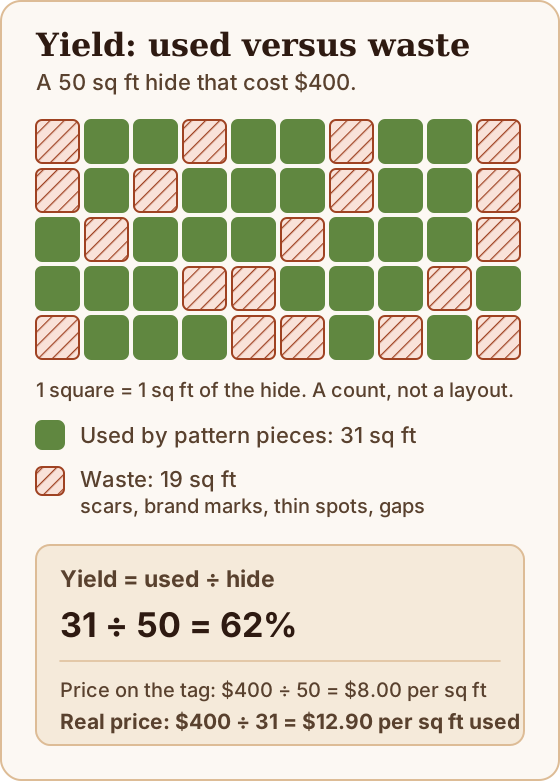
One bookkeeping guide for leather goods makers defines yield rate the same way: usable square footage divided by total square footage, after trimming for defects, brand marks and pattern waste. It also says natural defects alone often push scrap above 20% before layout waste is added. Your number will be different from anyone else's. That is the point of measuring it.
Step 1: Know the size of your hide
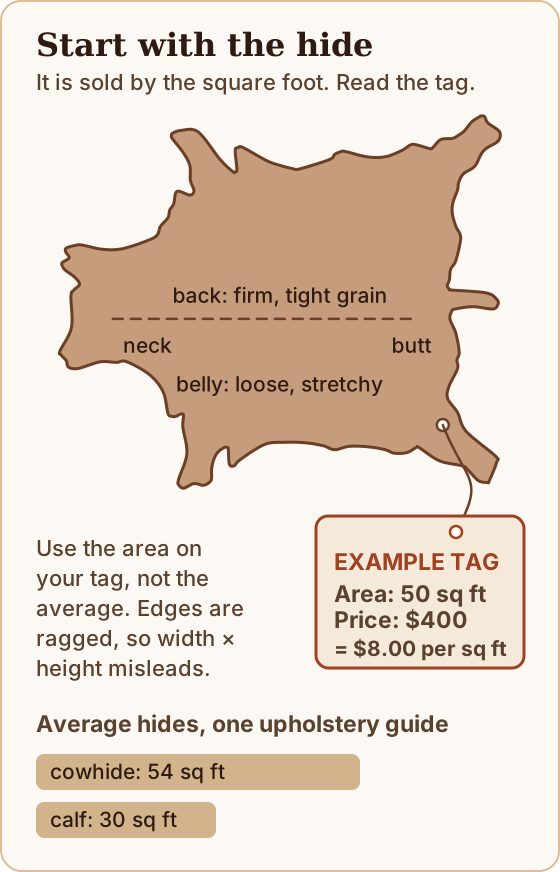
Hides are priced by the square foot, and a hide is not a standard size. One upholstery guide gives a cowhide average of about 54 square feet and a calf hide of about 30. Another example in the same guide uses 50. Read the invoice or the tag. Use the real number for the hide in front of you, not the average.
Step 2: Add up your pattern area
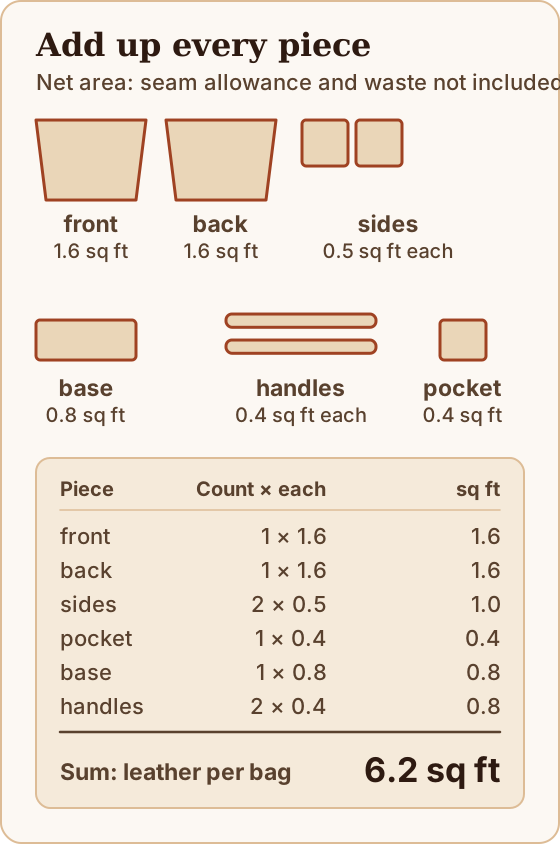
Add the area of every piece one product needs from this leather. Include the small ones: straps, gussets, tabs, pockets, edge-paint allowance if you cut it in. Small pieces are what fill the gaps, so they matter in the next step too.
For our example, a simple tote needs 6.2 square feet of leather per bag. Say you measured that from your pattern.
Step 3: Lay it out and count
This is the part no formula replaces. Put your pieces on the hide, or on a photo or scan of it. Cut around holes and scars. Keep grain direction where your design needs it. Then count how many full products you got.
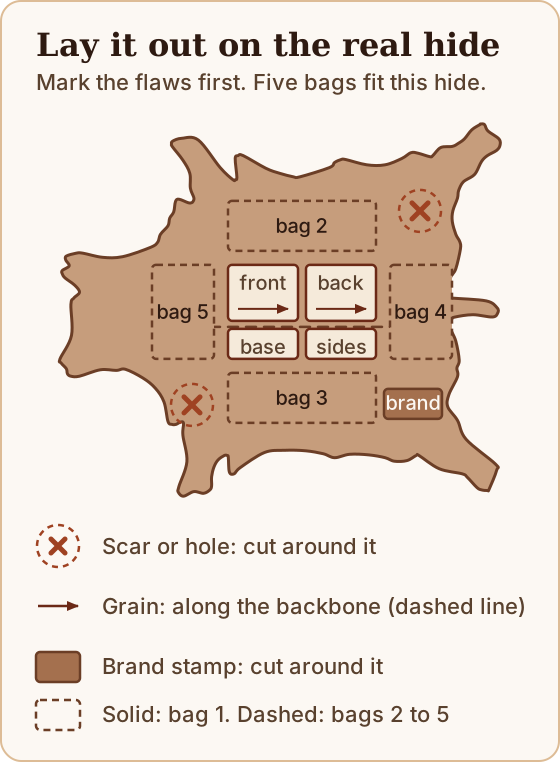
In our example, a 50 square foot hide gives five bags.
- Pieces placed: 5 bags × 6.2 sq ft = 31 sq ft
- Yield: 31 ÷ 50 = 62%
Step 4: Turn yield into a real price
Keep this formula near your cutting table:
Cost per usable sq ft = hide cost ÷ (hide area × yield)
The bookkeeping guide (Beancount.io) uses this formula. The hide in our example cost $400 delivered.
- Invoice price: $400 ÷ 50 sq ft = $8.00 per sq ft
- Real price: $400 ÷ (50 × 0.62) = $400 ÷ 31 = $12.90 per usable sq ft
Now cost one bag:
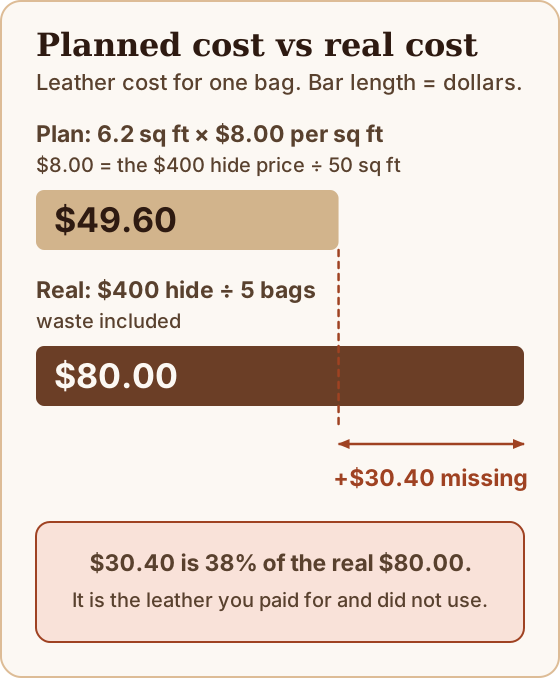
- Naive leather cost: 6.2 sq ft × $8.00 = $49.60
- Real leather cost: $400 ÷ 5 bags = $80.00
The naive number is $30.40 too low. That is 38% of the real cost, which matches the waste. If you price a bag from the invoice number, you give away your margin before you start.
Step 5: See what a few points of yield are worth
Say a customer orders 40 bags. Compare two hides of the same size and price.
| Yield | Pieces placed | Whole bags per hide | Hides for 40 bags | Leather cost | | --- | --- | --- | --- | --- | | 62% | 31.0 sq ft | 5 | 8 | $3,200 | | 55% | 27.5 sq ft | 4 (4.4 rounded down) | 10 | $4,000 |
Seven points of yield cost $800 on a 40-bag run. Notice the rounding. Yield only helps when it gives you one more whole product. Going from 4.4 to 4.9 bags per hide changes nothing, but 5.0 changes everything.
The bookkeeping guide also gives an example of a supplier switch that dropped yield from 68% to 55%. Same pattern, same price per foot, very different bill.
Four habits that cut cutting waste
We won't promise one percentage. No source we found gives a standard waste figure for handbags. For footwear, Wade Motawi's book How Shoes Are Made gives two data points from the factory side: under 5% cutting loss for mesh fabric, and as much as 20% for fine leather, because the factory cannot use leather with cuts or scars. Your own number depends on your pattern, your hide, and your skill. What we can tell you is what moves the number.
- Inspect and mark the hide first. Mark every defect with chalk before you place a single piece. Decide which pieces can sit on a flaw (linings, hidden gussets) and which need clean leather (the front panel).
- Place the big pieces, then fill. Put the large, picky pieces on the best areas. Fill the gaps with small pieces. Keep a stack of small pieces ready to drop in.
- Know your strict and loose pieces. Some pieces must follow grain and stretch direction. Others can turn a few degrees. Write that on the pattern so you don't re-decide at the table.
- Record the result every time. Write down hide size, cost, bags cut, and yield. After ten hides, you have a number you can trust for the next quote.
A rule from the upholstery guide is worth knowing too: it says the waste factor can be as high as 50% and suggests ordering double what you think you need for tricky jobs. That is a blunt rule built for furniture. For your own products, your recorded yield will beat any rule of thumb.
A note on ordering
Do not order the exact square footage. Divide the total pattern area you need by your recorded yield, then round up to whole hides. For 40 bags: 40 × 6.2 = 248 sq ft of pieces. At 62% yield, 248 ÷ 0.62 = 400 sq ft of hide. At 50 sq ft per hide, that is exactly 8 hides. Add a spare hide if your supplier's dye lots vary. A mismatched color halfway through a run is more expensive than one extra hide.
How MYC helps
Frank built Maker's Yield & Cost (MYC) because he wanted this math to live next to the costing, not in a notebook. MYC has a Leather Yields tool for pattern nesting and hide-area use, so you see the real waste on expensive leather. MYC also has BOM costing, so your leather numbers and the rest of your cost sheet live in the same app.
It does not replace the cutting table. You still need to look at the hide.
MYC is in a free academic beta for students, faculty and alumni with an active school email. No credit card. You can join at makersyield.com/en/campus-to-studio.
Sources
All web pages opened and read on 2026-11-03. The Motawi book is read from the author's copy.
- Beancount.io, Leather goods maker bookkeeping: cutting-room yield and tariffs guide. Yield rate definition, cost-per-usable-square-foot formula, scrap above 20% from defects, the 68% to 55% yield example.
- Wade Motawi, How Shoes Are Made (2018 edition), Shoemakers Academy. Chapter 14: cutting loss under 5% for mesh and up to 20% for fine leather.
- Kovi Fabrics, How Much Leather Do I Need to Order?. Average cowhide (about 54 sq ft) and calf hide (about 30 sq ft), the waste factor and the order-double advice.
All worked examples and drawings (the tote, the $400 hide, the 40-bag run) are our own illustration with made-up round numbers. They are not industry benchmarks.