Blog
handbag BOM
Handbag BOM Costing: A Simple Guide for Design Students
· Frank Vega
- handbag BOM
- bill of materials costing
- FOB price
- landed cost
- handbag design
- design students
By Frank Vega, founder of MYC
Many design students can draw a handbag. Far fewer can say what it costs to make.
That is a problem the first time a factory sends back a quote. Or the first time a buyer asks for your wholesale price. A costed bill of materials (BOM) is how you answer both. It is not hard. It is a list, a few multiplications, and some honesty.
Here is the whole thing for a simple leather tote, step by step.
The words you need
Three terms come up in every quote.
- BOM (bill of materials). Every material and trim used in one unit, with quantity and unit cost. One costing guide says a typical apparel BOM runs 8 to 25 line items. A tote has fewer, but the idea is the same.
- FOB (free on board) price. The price at the factory, plus loading onto the ship. A supplier-side guide describes it as the ex-factory cost plus the cost of loading goods onto the vessel. In practice, FOB covers materials, labor and the factory's margin. Responsibility passes to the buyer once the goods are loaded.
- Landed cost. What the product costs once it reaches your door: FOB plus freight, insurance, duties, and handling.
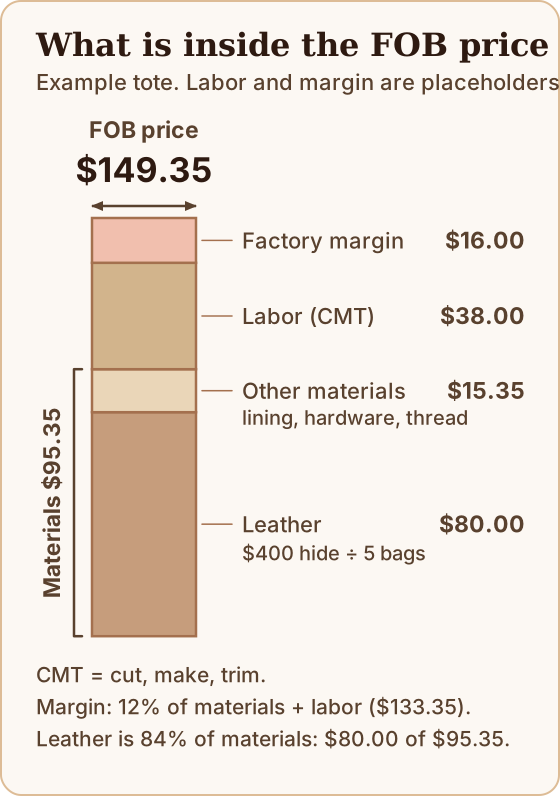
Another costing guide writes the first part as a formula: FOB = BOM + labor (CMT, "cut, make, trim") + factory margin.
Step 1: List every material
Open your tech sketch and walk around the bag. Write down everything you touch. Pull the bag apart on paper, like this:
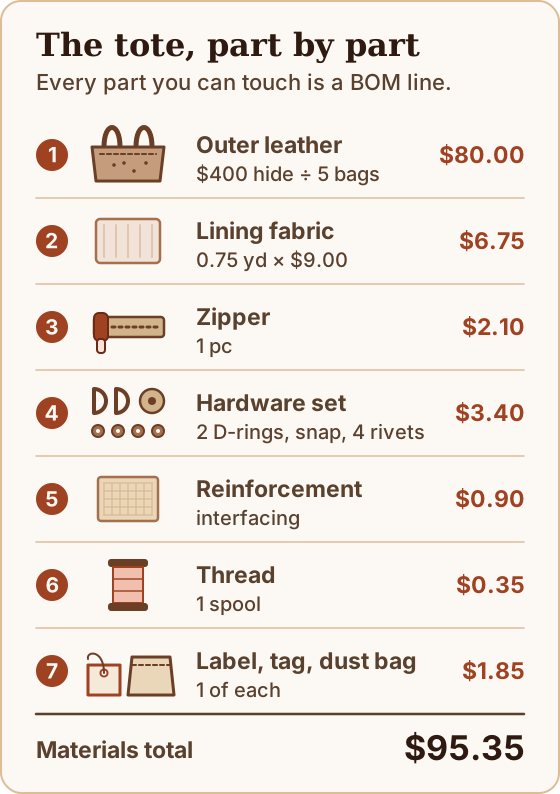
Each numbered part is one line in the table below. The numbers are made-up but realistic round numbers:
| Line | Quantity | Unit cost | Line cost | | --- | --- | --- | --- | | Outer leather | 6.2 sq ft | see below | $80.00 | | Lining fabric | 0.75 yd | $9.00 | $6.75 | | Zipper | 1 | $2.10 | $2.10 | | Hardware set (2 D-rings, snap, 4 rivets) | 1 set | $3.40 | $3.40 | | Reinforcement / interfacing | 1 | $0.90 | $0.90 | | Thread | 1 | $0.35 | $0.35 | | Label, tag, dust bag | 1 | $1.85 | $1.85 | | Materials total | | | $95.35 |
Check the math: 80.00 + 6.75 = 86.75. Add 2.10 → 88.85. Add 3.40 → 92.25. Add 0.90 → 93.15. Add 0.35 → 93.50. Add 1.85 → 95.35.
Every row works the same way. Here is one row, opened up:
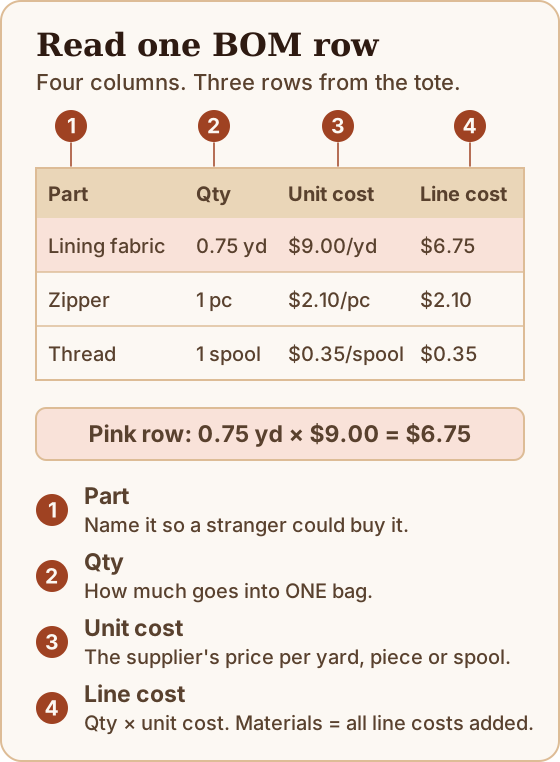
The leather line is not 6.2 × the price per foot
This is where students lose money. If the hide costs $8.00 per sq ft on the invoice, 6.2 sq ft looks like $49.60. But you do not get to use the whole hide. In our leather yield post a $400, 50 sq ft hide gives only 5 bags at 62% yield. So the leather cost per bag is $400 ÷ 5 = $80.00.
Leather is $80 of the $95.35, or 84% of the materials. Get this one line wrong and the whole costing is wrong. Always cost the leather from your real yield.
Step 2: Add labor
Labor is cut, make, and trim (CMT): the cost to cut and sew the bag. Ask your factory or sewing contractor for a per-unit price. For this example we will use $38.00. It is a placeholder. Your real number depends on the country, the factory, the construction, and the order size.
Step 3: Add the factory margin and reach FOB
Factories add a margin. Ask what it is. We will use 12% of materials plus labor, again as a placeholder.
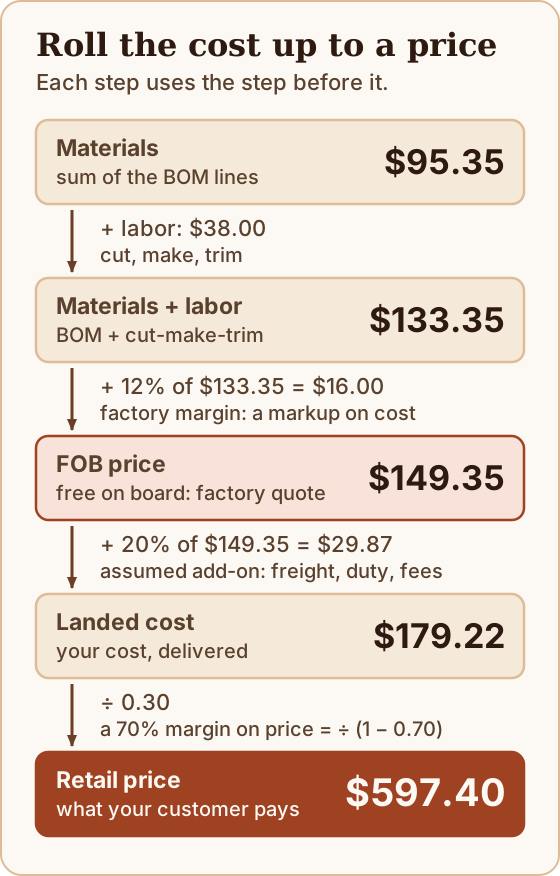
- Materials + labor: $95.35 + $38.00 = $133.35
- Factory margin at 12%: $133.35 × 0.12 = $16.00
- FOB price: $133.35 + $16.00 = $149.35
That is the unit price a factory would quote for the bag at the dock.
Step 4: Get from FOB to landed cost
FOB is not what the bag costs you. The costing guide says landed cost typically adds 15 to 30 percent on top of FOB for apparel imports, and warns that reporting margin from FOB alone overstates it by that much. We could not find a published number specific to handbags, so we will use the middle of that range, 20%, as a stand-in. Your freight forwarder and customs broker will give you the real figures.
- Landed add-on at 20%: $149.35 × 0.20 = $29.87
- Landed cost: $149.35 + $29.87 = $179.22
For a real shipment, the add-on breaks into pieces: ocean freight, marine insurance, customs broker fee, import duties, port handling, and delivery to your warehouse. Duty is a percentage of the declared value, and in general the rate depends on how the product is classified. Ask a customs broker. Do not guess.
Step 5: Work backward to a price
Students often start with the price they want and wonder why the bag does not fit. Start from the landed cost and apply the margin you need.
The costing guide gives gross margin targets. Direct-to-consumer retail: 70 to 75%. Wholesale: 40 to 50%. The formula is:
Price = landed cost ÷ (1 − margin)
For our tote at a 70% margin:
- $179.22 ÷ (1 − 0.70) = $179.22 ÷ 0.30 = $597.40
Here is the whole chain in one picture:
Is that a bag your customer will buy at about $597? If not, the problem is in the cost, not the price. Run the numbers backward. Say your market tops out at $400:
- Max landed cost at 70% margin: $400 × 0.30 = $120.00
- Max FOB (landed is FOB + 20%): $120.00 ÷ 1.20 = $100.00
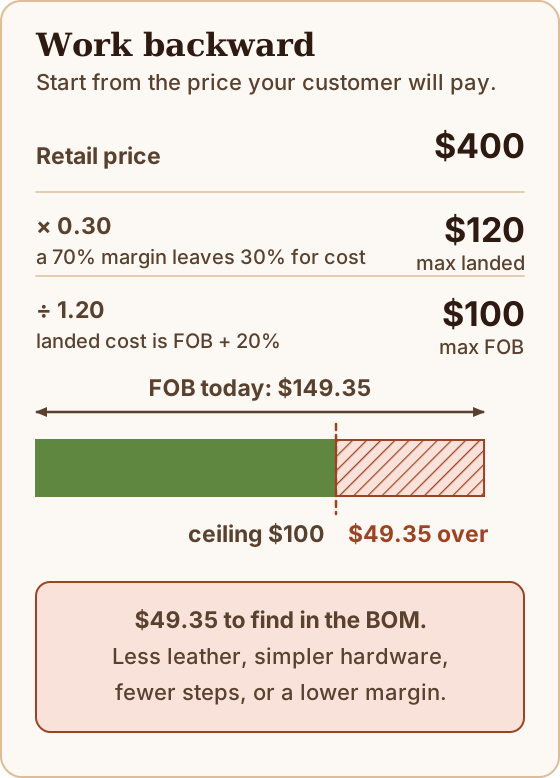
Your FOB is $149.35 and your ceiling is $100. Now you have a design conversation, not a guess. You could use less leather, change the hardware, simplify the construction, or accept a lower margin. Each choice shows up as a line in the BOM.
Common mistakes
- Costing leather from the invoice price. See Step 1.
- Forgetting the small lines. Thread, labels, packaging and hardware plating add up. Walk the bag again.
- Mixing up FOB and landed. A $149 FOB bag is not a $149 bag.
- Using one supplier quote forever. Prices move. Re-check before each order.
- Not saving your assumptions. Write down your yield, margin and landed add-on. Next season you will want them.
How MYC helps
Frank built Maker's Yield & Cost (MYC) to do this costing without a fragile spreadsheet. In MYC you build a live bill of materials, and a target FOB price updates as you design. When you change a material or a quantity, the cost changes with it. That makes the backward calculation in Step 5 fast, because you can try a change and see the effect.
MYC also produces a Tech Pack for your manufacturer. The numbers in this post stand without MYC. A spreadsheet and a calculator will work.
MYC is in a free academic beta for students, faculty and alumni with an active school email. No credit card. Join at makersyield.com/en/campus-to-studio.
Sources
All pages opened and read on 2026-11-03.
- Uphance, Garment costing and pricing. BOM line count (8 to 25), FOB = BOM + CMT + factory margin, landed adds 15 to 30 percent on FOB for apparel imports, gross margin targets, the price formula.
- Toolio, Landed cost vs FOB cost vs ex-factory cost. Definitions of ex-factory, FOB and landed cost, and the list of landed cost parts.
- Easyship, What is landed cost?. Duty as a percentage of declared value.
- Kovi Fabrics and Beancount.io sources for the leather side are listed in our leather yield post.
These sources cover apparel and general imports. We found no handbag-specific benchmark. The tote, the $38 labor, the 12% factory margin and the 20% landed add-on are our own placeholders for teaching, not industry figures.